Silent Curve
From Geometry of Desire
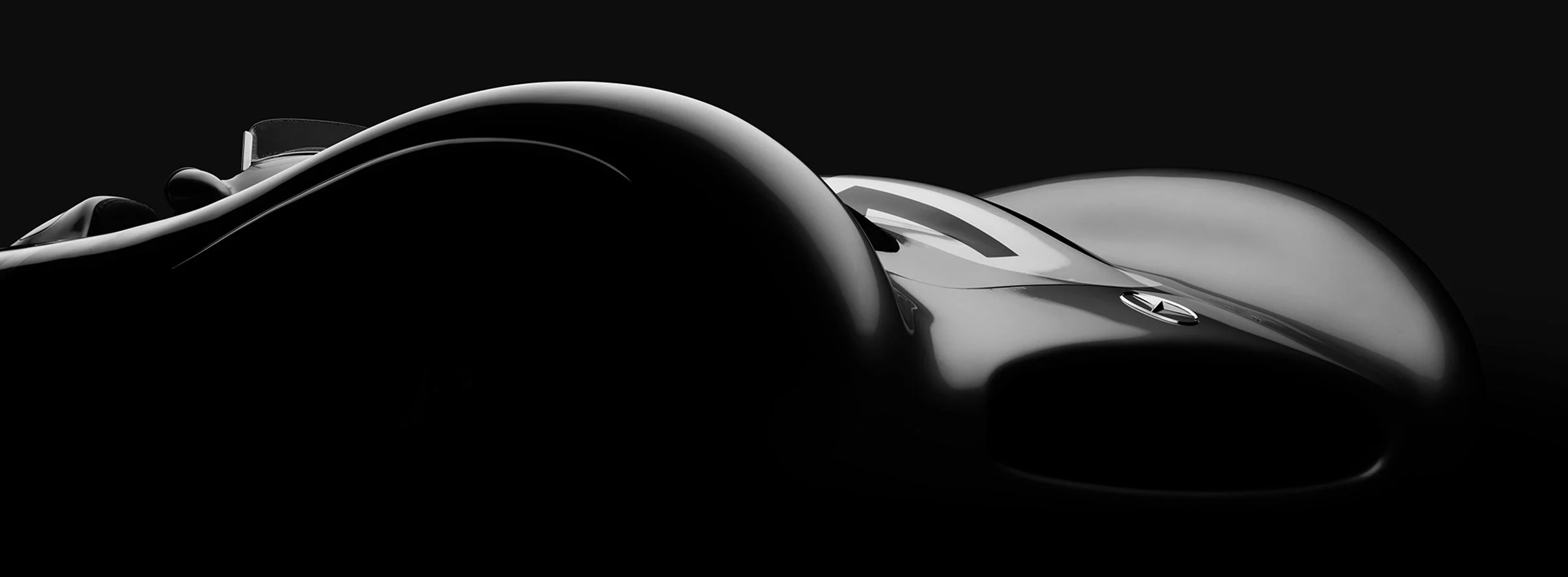
Mercedes-Benz W 196 R Streamliner
Available Editions
Collector Edition
24 × 16 in.
Archival pigment print
Edition of 15
Signed and numbered
$3,200
Large Format Edition
44 × 28 in.
Archival pigment print
Edition of 10
Signed and numbered
$9,000
Monumental Edition
Architectural scale
Available by private inquiry
Works are offered unframed. Custom framing may be arranged upon request.
Site-specific installations and architectural presentations may be considered by private inquiry.
Request to Acquire
About the Work
Silent Curve presents the Mercedes-Benz W 196 R Streamliner in a state of quiet suspension. Removed from the noise of racing, the car is held in darkness, where the essential curve of the body becomes the subject.
This image is not a description of the car, but a reduction of it — a study of line, surface, proportion, and the silence that remains after speed has passed.
The Car
Introduced in 1954, the Mercedes-Benz W 196 R marked Mercedes-Benz’s return to Grand Prix racing after World War II and immediately reestablished the marque at the highest level of international motorsport.
In streamlined form, the W 196 R debuted at the 1954 French Grand Prix at Reims, where Juan Manuel Fangio and Karl Kling finished first and second for Mercedes-Benz. The enclosed-wheel body was developed for high-speed circuits, reducing drag and giving the car its extraordinary uninterrupted form.
Driven by figures including Fangio and Stirling Moss, the W 196 R helped Mercedes-Benz secure the Formula One Drivers’ World Championship in both 1954 and 1955. Its lasting power lies not only in engineering, but in presence — a racing machine shaped by speed, remembered for restraint.
The Process
Bill Pack’s Painting with Light process is performed in controlled darkness. Using hand-held light, he guides illumination across the surface of the car in deliberate, measured passes, allowing form, proportion, and reflection to emerge with restraint.
The process is not documentation of a single moment. It is an authored gesture of light across structure — a way of revealing the presence, tension, and design language held within the subject.